Energetic Advantages for Quantum Agents in Online Execution of Complex Strategies (Phys. Rev. Lett. 135, 160402)

In this article, we asked: ”Can an agent equipped with quantum memory fundamentally exhibit an energetic advantage over its classical counterparts?“ What we found is that for autonomous agents, there exists a fundamental dissipative energetic cost arising from the need to be ready for every possible contingency. As an analogy, imagine preparing for a day ... Read moreEnergetic Advantages for Quantum Agents in Online Execution of Complex Strategies (Phys. Rev. Lett. 135, 160402)
Undecidability in Physics: A Review(Physics Reports 1138, 1–29)

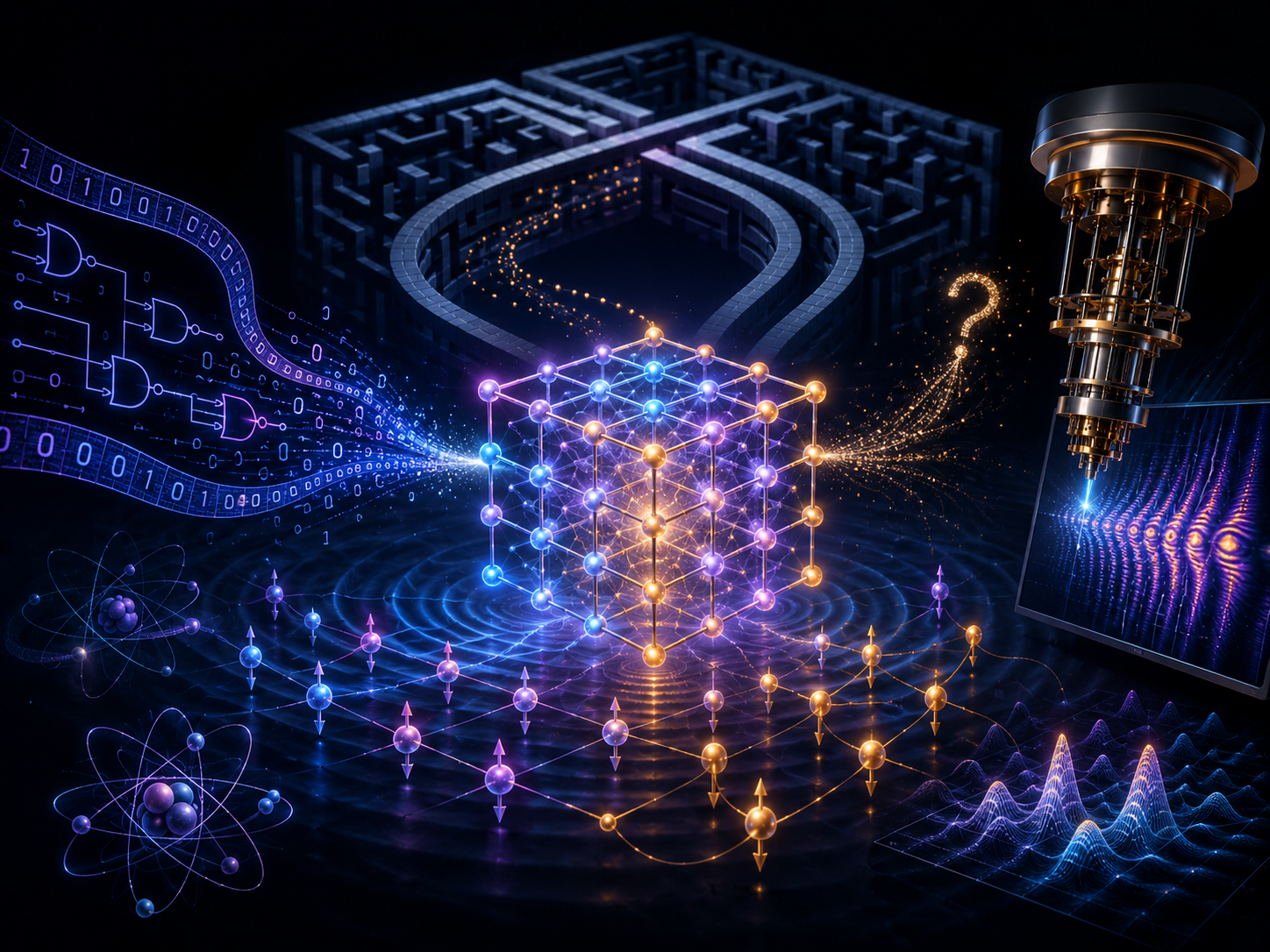
Some questions are hard because we have not yet found the right method. Others are hard in a deeper sense: no algorithm can solve them in full generality. This idea, known as undecidability, began in mathematics and computer science with the work of Gödel, Church, and Turing. It shows that even with perfect logic and ... Read moreUndecidability in Physics: A Review(Physics Reports 1138, 1–29)

Dimension reduction in quantum sampling of stochastic processes (npj Quantum Information volume 11, 34)

Many problems in science, engineering, and finance involve generating samples from complex probability distributions. Classically, such samples are usually the end of the story: one draws random outcomes and then analyzes them. Quantum samples are more powerful. By encoding many possible outcomes coherently in a quantum state, they can be passed directly into other quantum ... Read moreDimension reduction in quantum sampling of stochastic processes (npj Quantum Information volume 11, 34)

Relative Entropy of Coherence Quantifies Performance in Bayesian Metrology (PRX Quantum 5, 030303)

Quantum sensors aim to reveal tiny hidden signals, such as small shifts in light, magnetic fields, time, or motion. Their power often comes from one of the strangest features of quantum physics: superposition, where a system can occupy multiple possibilities at once. This quantum “coherence” can carry valuable information about the signal being measured. Yet ... Read moreRelative Entropy of Coherence Quantifies Performance in Bayesian Metrology (PRX Quantum 5, 030303)

Quantum-optimal information encoding using noisy passive linear optics (Quantum 8, 1218)

Determining the maximal amount of information that can be reliably transmitted through a noisy channel is a key question in information theory. This study delves into a class of optical quantum channels that stand out for their practicality: they do not require an external energy source for their operation. By focusing on these channels, the ... Read moreQuantum-optimal information encoding using noisy passive linear optics (Quantum 8, 1218)

Quantum Uncertainty Principles for Measurements with Interventions (Phys. Rev. Lett. 130, 240201)

Interactive measurements represent the most powerful way in which agents can learn about their environments. When toddlers want to understand cause and effect for example, they don't merely observe. Instead they try different actions, and observe the reactions. This interactivity is key to learning the causal relations between objects. As such, in Artificial intelligence and ... Read moreQuantum Uncertainty Principles for Measurements with Interventions (Phys. Rev. Lett. 130, 240201)

Implementing quantum dimensionality reduction for non-Markovian stochastic simulation (Nat Commun 14, 2624)

Complex systems such as traffic patterns weather forecasts, and financial markets are ‘stochastic’ processes typically modelled by storing vast amounts of information about events in the past – which quickly consumes lots of memory. The downside of of this is not only resource cost. The more things a model tracks, the harder it is to ... Read moreImplementing quantum dimensionality reduction for non-Markovian stochastic simulation (Nat Commun 14, 2624)

Thermodynamic machine learning through maximum work production (New J. Phys. 24 083040)

Adaptive systems, ranging from living organisms to autonomous robots, exhibit the ability to thrive by effectively utilizing the resources in their environments. Often this requires learning models of their environment, such that the agent can best understand what to anticipate in the future depending on past expereincces. However, such adaptive systems are physical, and so ... Read moreThermodynamic machine learning through maximum work production (New J. Phys. 24 083040)

Space-efficient optical computing with an integrated chip diffractive neural network (Nat Commun 13, 1044)

Optical neural networks (ONNs) are a rapidly developing field of technology that uses light to perform complex computing tasks. Until now, most ONNs have been large and power-hungry, limiting their practical use. Traditional approaches rely on units called Mach-Zehnder interferometers (MZIs) for their calculations. For large-scale computations, this approach can require an excessive amount of units ... Read moreSpace-efficient optical computing with an integrated chip diffractive neural network (Nat Commun 13, 1044)

Collaborative computing goes Quantum

In the Lego movie a master builder possesses the jedi like powers of being able to construct different getaway vehicles such as flying couches simply by cobbling together stray blocks and repurposed parts of existing structures. These constructions are only limited by the master builder’s imagination (ok and some engineering principles on the limits of ... Read moreCollaborative computing goes Quantum