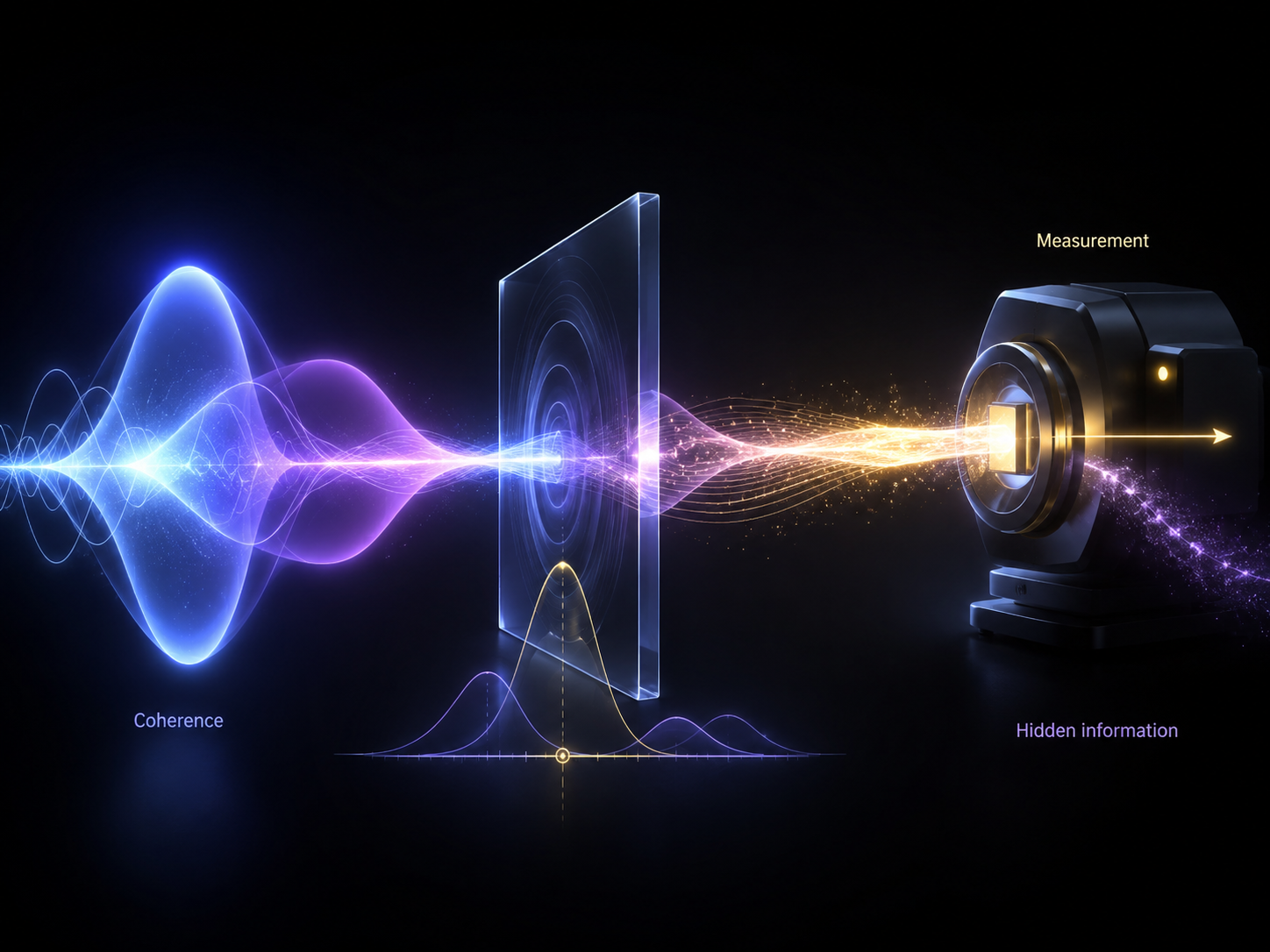
Quantum sensors aim to reveal tiny hidden signals, such as small shifts in light, magnetic fields, time, or motion. Their power often comes from one of the strangest features of quantum physics: superposition, where a system can occupy multiple possibilities at once. This quantum “coherence” can carry valuable information about the signal being measured. Yet this information is not always easy to access. Depending on how the quantum system is measured, some of the information can remain locked away, present in the quantum state but invisible in the final measurement result.
Here, we show that a standard measure of quantum coherence has a direct meaning in Bayesian metrology, a framework for estimating unknown quantities from uncertain data. The key result is a simple relation, called the CXI equality, showing that coherence quantifies the gap between the best possible information available in a quantum system and the information actually extracted by a chosen measurement. In this sense, coherence tells us how much useful information remains hidden from a measurement, and how much could potentially be gained by using a better or more collective measurement strategy. The result applies broadly, including to unitary, dissipative, and discrete sensing tasks, and provides a new way to understand precisely when quantum features improve measurement.
<p><a href="https://journals.aps.org/prxquantum/abstract/10.1103/PRXQuantum.5.030303" title="">Relative Entropy of Coherence Quantifies Performance in Bayesian Metrology</a><br>Lecamwasam, Ruvi and Assad, Syed and Hope, Joseph J. and Lam, Ping Koy and Thompson, Jayne and Gu, Mile<br>PRX Quantum 5, 030303 </p>