Fundamental limits of quantum error mitigation (npj Quantum Inf 8, 114)

The unavoidable accumulation of errors in quantum devices is consider a key hurdle in unlocking the full potential of quantum computing. In this, current generation quantum computers cannot do adaptive error correction and are thus limited to error-mitigation - a process of supressing errors without actively making measurements and adapting computation to their outcomes.  Here ... Read moreFundamental limits of quantum error mitigation (npj Quantum Inf 8, 114)
Thermodynamic machine learning through maximum work production (New J. Phys. 24 083040)

Adaptive systems, ranging from living organisms to autonomous robots, exhibit the ability to thrive by effectively utilizing the resources in their environments. Often this requires learning models of their environment, such that the agent can best understand what to anticipate in the future depending on past expereincces. However, such adaptive systems are physical, and so ... Read moreThermodynamic machine learning through maximum work production (New J. Phys. 24 083040)

Optimal Gain Sensing of Quantum-Limited Phase-Insensitive Amplifiers (Phys. Rev. Lett. 128, 180506)

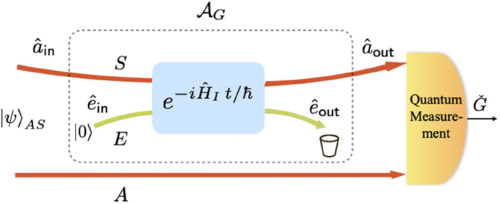
While significant work has been done in understanding how non-classical optical probes and enhance our ability to measure and detect loss in a channel, far less has been done about measuring gain. Here we focus on Phase-insensitive optical amplifiers that amplify input light-beams in a way that is phase-independent. We showed that unlike in the ... Read moreOptimal Gain Sensing of Quantum-Limited Phase-Insensitive Amplifiers (Phys. Rev. Lett. 128, 180506)

Space-efficient optical computing with an integrated chip diffractive neural network (Nat Commun 13, 1044)

Optical neural networks (ONNs) are a rapidly developing field of technology that uses light to perform complex computing tasks. Until now, most ONNs have been large and power-hungry, limiting their practical use. Traditional approaches rely on units called Mach-Zehnder interferometers (MZIs) for their calculations. For large-scale computations, this approach can require an excessive amount of units ... Read moreSpace-efficient optical computing with an integrated chip diffractive neural network (Nat Commun 13, 1044)

Characterizing correlation within multipartite quantum systems via local randomized measurements

Given a quantum system on many qubits split into a few different parties, how many total correlations are there between these parties? Such a quantity, aimed to measure the deviation of the global quantum state from an uncorrelated state with the same local statistics, plays an important role in understanding multipartite correlations within complex networks ... Read moreCharacterizing correlation within multipartite quantum systems via local randomized measurements

Quantum Adaptive Agents with Efficient Long-Term Memories (Phys. Rev. X 12, 011007)

To thrive in ever-changing environments, systems must be able to adapt their actions to respond appropriately to the stimuli they receive. These adaptive systems, or agents, exist at all scales, from microscopic bacteria to self-driving vehicles. Common to all is that they interact and compete with other agents, mounting a drive to develop and deploy ... Read moreQuantum Adaptive Agents with Efficient Long-Term Memories (Phys. Rev. X 12, 011007)

Thermodynamic machine learning through maximum work production

In this work, we decided to look at the relations between two seemingly rather disconnected concepts - free energy extraction, and machine learning. it turns out though, that the two concepts hold rich relations. Notably, for a demon to be able to extra the greatest work from a pattern, he needs to have a mental ... Read moreThermodynamic machine learning through maximum work production

Impossibility of achieving Landauer's bound for almost every quantum state

The thermodynamic cost of resetting an arbitrary initial state to a particular desired state is lower bounded by Landauer's bound. However, here we demonstrate that this lower bound is necessarily unachievable for every initial state (except possibly the single minimally dissipative input) for any reliable reset mechanism. Since local heating threatens rapid decoherence, this issue ... Read moreImpossibility of achieving Landauer's bound for almost every quantum state

Interfering trajectories in experimental quantum-enhanced stochastic simulation Nature Communications, 10, 1630)

In the 2018 movie Infinity War, a scene featured Dr. Strange looking into 14 million possible futures to search for a single timeline where the heroes would be victorious. Perhaps he would have had an easier time with help from a quantum computer. In with work, we worked with colleagues from Griffith university to constructed ... Read moreInterfering trajectories in experimental quantum-enhanced stochastic simulation Nature Communications, 10, 1630)