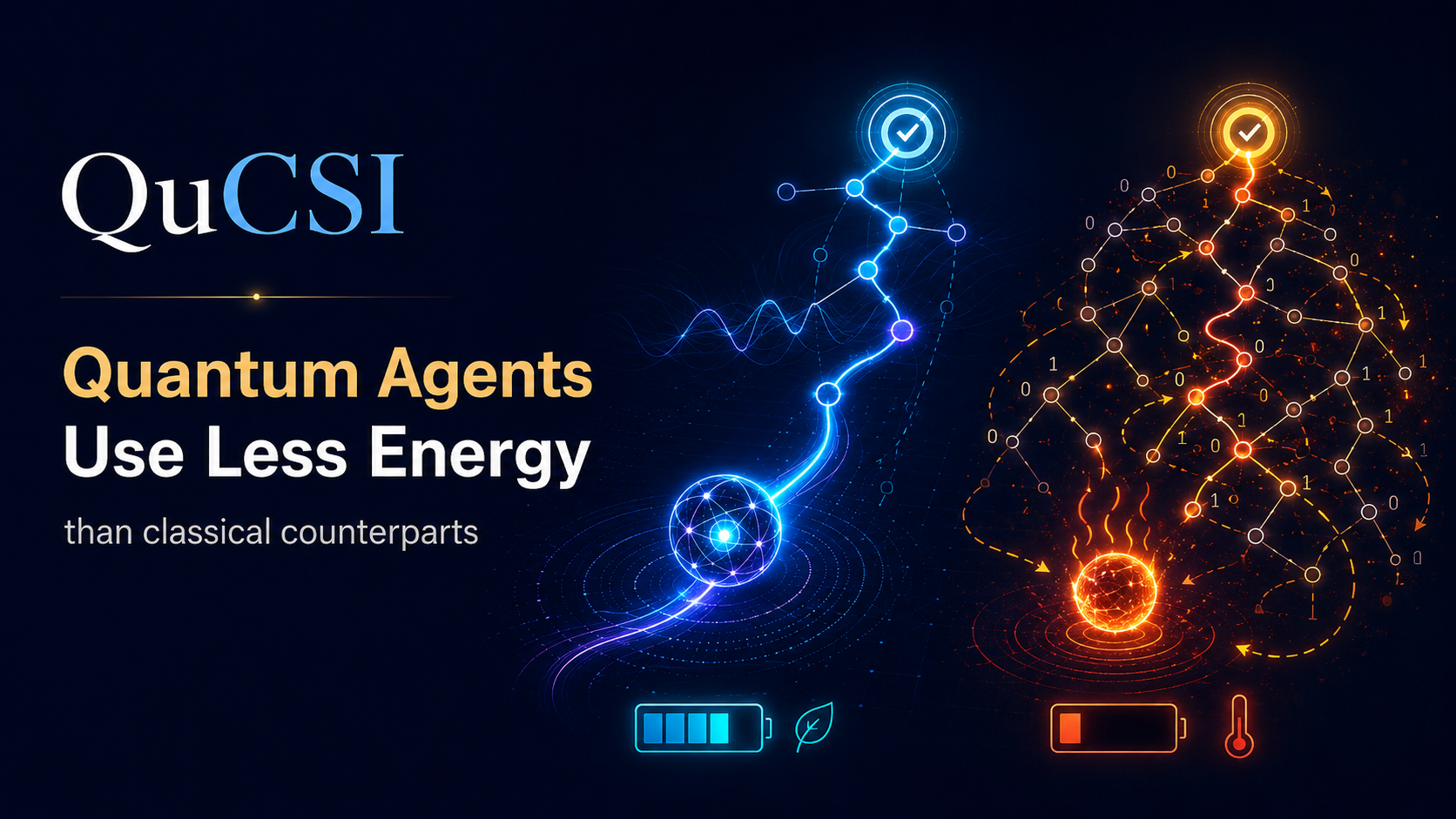
In this article, we asked: ”Can an agent equipped with quantum memory fundamentally exhibit an energetic advantage over its classical counterparts?“ What we found is that for autonomous agents, there exists a fundamental dissipative energetic cost arising from the need to be ready for every possible contingency.
As an analogy, imagine preparing for a day out when there’s an equal chance of rain or sun. Unsure which will occur, you decide to take both sunglasses and an umbrella. Regardless of the weather, one of these items will be carried in vain — representing wasted effort.
We discovered that the same principle applies to information. Depending on future outcomes, some stored information may turn out to be unnecessary — yet an agent must still maintain it to stay ready for any contingency. This “readiness,” we show, inevitably causes irreversible energy dissipation. As tasks grow more complex, this dissipative cost can increase without bound — and it persists even for the provably most efficient, well-optimized classical models. Remarkably, quantum agents can mitigate this cost below classical limits. By encoding many potentially useful bits of information within the same qubit, they can reproduce classical behavior while achieving energy savings that also scale without bound.
- Energetic Advantages for Quantum Agents in Online Execution of Complex Strategies
Jayne Thompson, Paul M. Riechers, Andrew J. P. Garner, Thomas J. Elliott, and Mile Gu
Phys. Rev. Lett. 135, 160402